Major wars are terrible for some investors
Hilliard MacBeth - Feb 27, 2026
War, What Is It Good For?
“War, what is it good for? Absolutely nothing.”
This 1970 lyric from The Temptations captured the anger of the Vietnam era. But in financial markets, war is good for one thing: inflation.
A February 2026 academic study examining 300 years of U.S. and U.K. data reaches a blunt conclusion: government bonds are not safe during a major war.
Across major wars since the 1700s, real returns on government debt were sharply negative. The average decline in bond portfolios was 14% over several years. During World War I, U.S. bondholders lost roughly 40% in real terms.
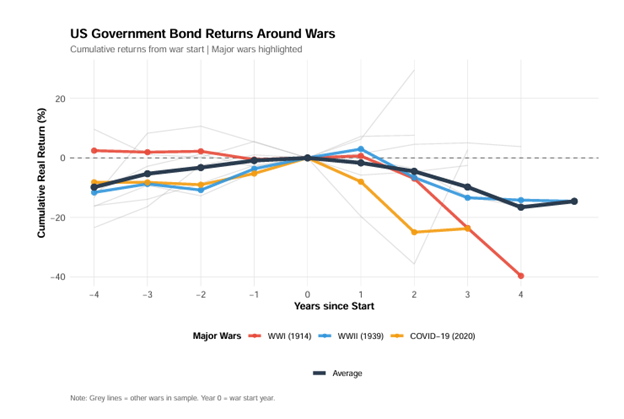
Source: Jiang et al, 2026. National Bureau of Economic Research
Returns in U.K. government bonds were even worse.
Why?
Wars explode government spending. Deficits surge. Inflation follows. Bondholders pay the price.
Recessions and financial crises usually benefit bonds because inflation falls and investors flee to safety. War is different. Defense spending increases far more dramatically than in financial crises.
Today the U.S. already runs massive peacetime deficits. A meaningful expansion in defense spending would add fuel to an already inflation-prone fiscal position.
President Trump has proposed an increase of $153 billion in defense spending for 2026 from a base of about $900 billion, and a further $500 billion to $1.5 trillion in 2027, although Congress has not yet approved it.
And this is happening without any major conflict involving the U.S.!
If a major war were to break out, bonds would likely finance it — not protect investors from it.
That may explain why more tangible assets — real estate, inflation-protected securities, and gold — have attracted strong demand. Gold has made the biggest move recently, to more than $5,000 per ounce.
History is clear: in wartime, some “safe” assets often aren’t.
Hilliard MacBeth
The opinions expressed in this report are the opinions of the author and readers should not assume they reflect the opinions or recommendations of Richardson Wealth Limited or its affiliates. Richardson Wealth Limited is a subsidiary of iA Financial Corporation Inc. and is not affiliated with James Richardson & Sons, Limited. Richardson Wealth is a trade-mark of James Richardson & Sons, Limited and Richardson Wealth Limited is a licensed user of the mark. Richardson Wealth Limited, Member Canadian Investor Protection Fund.