Canada holds powerful weapons in the trade war
Hilliard MacBeth - Aug 28, 2026
Canada has a weapon in its trade war with the United States. It is powerful, it is immediate, and it has barely been mentioned in public. It is oil.
When Prime Minister Carney said "You're at war when you get attacked. We got attacked," he was not speaking loosely. He was signalling that Canada is prepared to think seriously about leverage it has never used before.
That leverage is substantial. Canada ships approximately 4.2 million barrels per day of heavy crude to the United States — roughly 63 percent of all U.S. crude imports. Most flows to refineries in the Midwest and Rocky Mountain states. There is almost no storage buffer at the U.S. end of the pipeline. A disruption would hit gasoline and diesel prices within days, not weeks — arriving just as the November midterm elections do.
The timing could not be more politically toxic for the White House. U.S. fuel prices are already elevated by the Iran conflict and record crack spreads. Canadian heavy crude is the preferred feedstock for Midwest refineries precisely because it yields a higher proportion of diesel — the most valuable, refined product in the current market — and arrives at a discount to world prices. The refiners processing it are currently earning $20 to $40 per barrel in margin. Cutting off that supply would collapse those margins and send pump prices sharply higher across the American heartland.
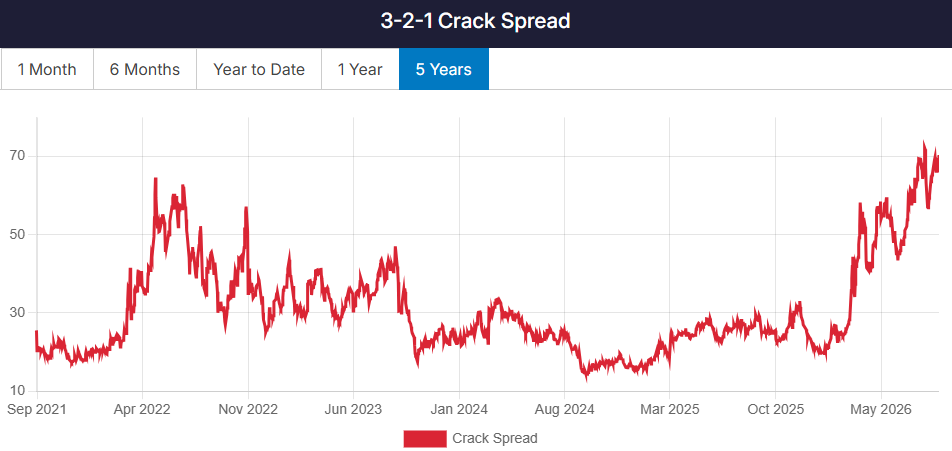
Source: Energy Information Administration - The 3-2-1 Crack spread approximates a theoretical refinery crude yield that produces two barrels of gasoline and one barrel of diesel for every three barrels of crude input. In other words, the simplified refinery yield implied by this calculation is two-thirds gasoline, one-third diesel. It is calculated in $/bbl.
Carney spelled out the full scope of Canadian energy leverage with characteristic precision: Canada supplies 99 percent of U.S. natural gas imports, 85 percent of U.S. electricity imports, and 60 percent of U.S. crude oil imports. Trump, who failed to anticipate that Iran would retaliate by closing the Strait of Hormuz, appears equally to have ignored the deeply integrated nature of North American energy supply — and the leverage it hands Canada.
The trade surplus that infuriates Trump tells the real story. It exists entirely because of Canadian oil exports, which generate approximately US$150 billion annually. Strip out those hydrocarbons and Canada runs a deficit with the United States — Canadians buy far more American goods than Americans buy Canadian ones. The surplus is not a sign of Canadian advantage. It is a sign of American dependence.
But the oil weapon cuts both ways. Alberta has almost no alternative customers for its landlocked crude — the Trans Mountain Pipeline offers some Pacific access, but most of Alberta's production has only one buyer. Turning off the taps would hurt Alberta as quickly as it hurt the Midwest.
Carney is right to think carefully. Both sides have enormous exposure. The difference is that Trump has shown he does not always think through the consequences of his escalations — the Iran war being the most costly example. Carney, by contrast, is making sure Washington understands exactly what is at stake.
It could be a big enough threat to make the other side blink first.
Hilliard MacBeth
The opinions expressed in this report are the opinions of the author and readers should not assume they reflect the opinions or recommendations of Richardson Wealth Limited or its affiliates. Richardson Wealth Limited is a subsidiary of iA Financial Corporation Inc. and is not affiliated with James Richardson & Sons, Limited. Richardson Wealth is a trade-mark of James Richardson & Sons, Limited and Richardson Wealth Limited is a licensed user of the mark. Richardson Wealth Limited, Member Canadian Investor Protection Fund.