The U.S. government may be heading for a debt crisis
Hilliard MacBeth - Sep 04, 2026
The size of the U.S. government's debt has become an increasingly important topic for investors, economists, and policymakers.
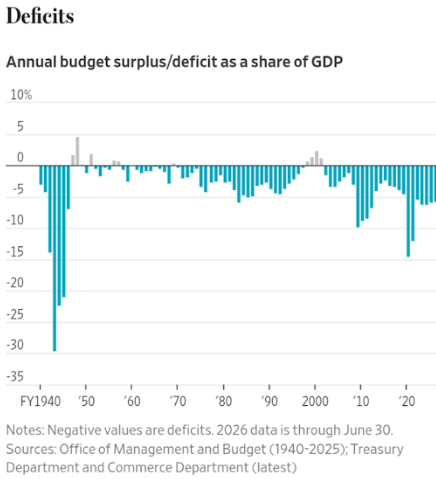
Federal debt has now surpassed $40 trillion, while annual budget deficits remain elevated. In recent years, the government has consistently spent more than it collects in revenue, resulting in additional borrowing to finance the gap.
According to government data, the federal deficit is currently running at roughly 6 percent of GDP, a level that is high by historical standards outside of periods of war or major economic crises. While there is ongoing debate about how sustainable this path may be, many economists agree that rising debt levels deserve attention.
A significant portion of government spending now goes toward areas such as Social Security, healthcare programs, and interest payments on existing debt. Interest costs alone are expected to remain a major budget item as borrowing levels increase and older debt is refinanced at current interest rates.
These spending commitments can make fiscal policy difficult to change quickly. Programs such as Social Security and Medicare serve millions of Americans and have broad public support, while national defence remains another major area of spending. As a result, discussions about reducing deficits often involve complex political and economic trade-offs.
At the same time, businesses continue to invest heavily in areas such as artificial intelligence, technology infrastructure, and data centres. This raises an important question for economists and market participants: how will financial markets absorb both significant government borrowing and substantial private-sector investment demands?
These broader fiscal trends also form part of the backdrop for decisions made by the U.S. Federal Reserve. The Fed's mandate includes promoting price stability and supporting employment, and its policy decisions influence borrowing costs throughout the economy.
Investors will be paying close attention to upcoming inflation data and Federal Reserve communications. However, the future path of interest rates remains uncertain and will depend on a range of economic indicators, financial conditions, and policy considerations.
What appears less controversial is that the long-term trajectory of government debt will ultimately depend on fiscal policy decisions made in Washington. While the Federal Reserve can influence financial conditions through monetary policy, decisions regarding government spending and taxation remain the responsibility of Congress and the administration.
For long-term investors, the key takeaway is not to predict the next policy move, but to recognize that debt, deficits, inflation, and interest rates are increasingly interconnected. These factors are likely to remain important themes for markets in the years ahead.
Hilliard MacBeth
The opinions expressed in this report are the opinions of the author and readers should not assume they reflect the opinions or recommendations of Richardson Wealth Limited or its affiliates. Richardson Wealth Limited is a subsidiary of iA Financial Corporation Inc. and is not affiliated with James Richardson & Sons, Limited. Richardson Wealth is a trade-mark of James Richardson & Sons, Limited and Richardson Wealth Limited is a licensed user of the mark. Richardson Wealth Limited, Member Canadian Investor Protection Fund.