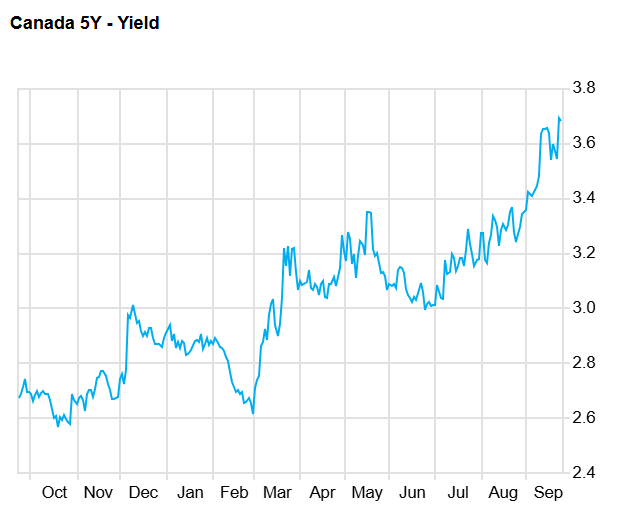
Higher bond yields are starting to matter at home
Fraser Betkowski - Sep 25, 2026
If you've been following the financial news lately, you've
probably noticed a recurring theme: bond yields are rising again.
While bond markets rarely make front-page news, they have a
direct impact on the borrowing costs that Canadians face every day. Higher bond
yields influence everything from government financing costs to fixed mortgage
rates, making this an important story for investors and homeowners alike.
The latest move higher has been driven largely by
surprisingly strong economic data in the United States. Rather than signalling
a looming recession, recent reports suggest the U.S. economy continues to grow
at a healthy pace. Investors are increasingly accepting that interest rates may
stay higher for longer, and that reality has pushed longer-term bond yields
upward.
For Canadians, this matters because our bond
market does not operate in isolation. U.S. Treasury yields often influence
Canadian government bond yields, which in turn help determine fixed mortgage
rates. Even if the Bank of Canada leaves its overnight rate unchanged, rising
bond yields can still result in higher borrowing costs for homeowners renewing
their mortgages.
We're already seeing the effects. Housing activity in
several major Canadian markets has slowed considerably compared to the frenzied
pace of 2020 and 2021. Higher mortgage payments have reduced affordability,
particularly for first-time buyers. Many homeowners renewing today are doing so
at rates well above what they secured during the pandemic years, creating
additional pressure on household budgets.
What's particularly interesting is that higher yields do not
appear to be driven primarily by fears of runaway inflation. Instead, much of
the increase reflects stronger economic growth and higher "real"
interest rates. In simple terms, investors are demanding a higher return on
their money because economic conditions remain relatively resilient.
Another factor worth watching is the extraordinary amount of
debt being issued to fund artificial intelligence infrastructure. Technology
giants are spending hundreds of billions of dollars on data centres, chips,
power infrastructure, and network capacity. While analysts debate how
significant the impact has been, basic economics suggests that a substantial
increase in bond issuance means more supply for investors to absorb.

When more bonds come to market, investors may demand higher
yields to purchase them. Governments are simultaneously issuing debt to finance
deficits, creating another source of supply. Whether AI-related financing is a
major driver or simply one contributor, it is difficult to imagine that this
wave of issuance is having no effect on borrowing costs.
The broader takeaway for investors is that we may be
entering a period where money is no longer as cheap as it was during the
previous decade. The exceptionally low interest rates of 2020 and 2021 now look
increasingly like an extraordinary period rather than the norm.
For homeowners, that means mortgage renewals will remain an
important planning consideration. For investors, higher bond yields can create
opportunities in fixed income while also changing how companies, governments,
and consumers borrow and spend.
Bond markets may not be exciting, but they often
tell us where the economy is headed before the headlines do. Right now, they
are signalling that higher borrowing costs are likely to remain part of the
landscape for some time.
Fraser Betkowski
The opinions expressed in this report are the opinions of the author and readers should not assume they reflect the opinions or recommendations of Richardson Wealth Limited or its affiliates. Richardson Wealth Limited is a subsidiary of iA Financial Corporation Inc. and is not affiliated with James Richardson & Sons, Limited. Richardson Wealth is a trade-mark of James Richardson & Sons, Limited and Richardson Wealth Limited is a licensed user of the mark. Richardson Wealth Limited, Member Canadian Investor Protection Fund.