The U.S. mid-term elections are starting to get interesting
Fraser Betkowski - Oct 09, 2026
A client recently sent me an email asking whether I was paying attention to next month's U.S. mid-term elections and what the implications might be for investors.
The short answer is yes.
While markets have spent much of 2026 focused on interest rates, government debt, artificial intelligence, and economic growth, the political backdrop is becoming increasingly difficult to ignore.
At present, Democrats appear to have a reasonable chance of retaking the House of Representatives. The Senate remains much closer. Republicans currently hold a 53-47 advantage, and Democrats would need to gain four seats to secure control. Several key races remain extremely competitive, making the Senate outcome far less certain than the House.
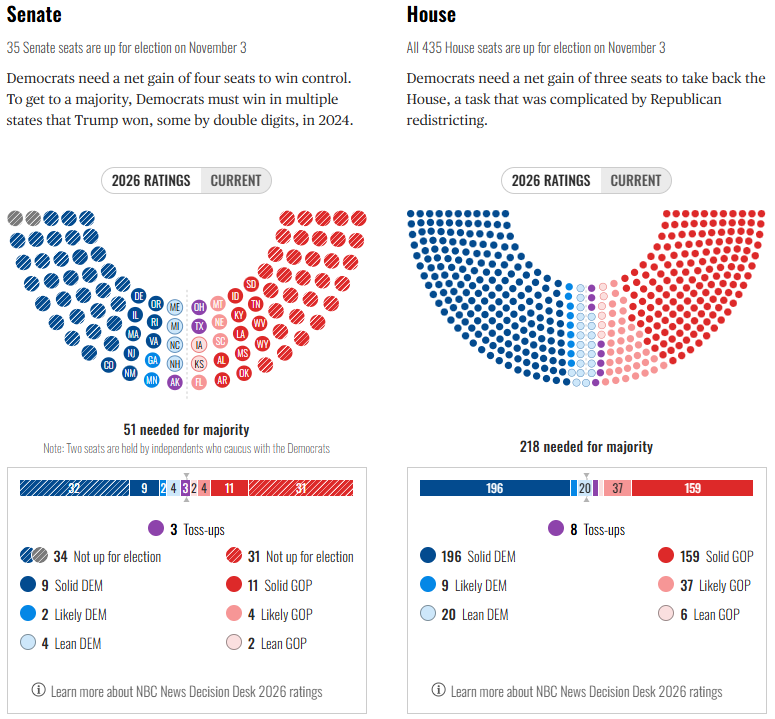
Source: NBC News
As is often the case in mid-term elections, the vote is shaping up less as a debate over ideology and more as a referendum on the economy. Voters continue to express concerns about affordability, energy costs, and the cost of everyday necessities.
From an investment standpoint, however, the political outcome itself may be less important than many believe.
Markets tend to dislike uncertainty. Once an election result becomes known, investors can begin assessing the likely path for taxes, regulation, government spending, and trade policy. Historically, stock markets have often performed well following mid-term elections regardless of which party wins.
The outcome many political observers currently expect is a divided Congress, with Democrats taking the House and Republicans narrowly retaining control of the Senate. While this sort of political gridlock can be frustrating for politicians, investors often view it more favourably. A divided government generally limits the likelihood of major policy changes, making the future somewhat easier to forecast.
Of course, politics remains only one variable among many. Corporate earnings, interest rates, inflation, government borrowing costs, and economic growth remain far more important long-term drivers of investment returns.
Still, as we move closer to election day, the U.S. political landscape is becoming increasingly relevant. We will be watching closely, particularly for any implications on fiscal policy, trade, and government spending.
For now, the most likely market takeaway may be the simplest one: investors generally prefer the status quo to the unknown.
Fraser Betkowski
The opinions expressed in this report are the opinions of the author and readers should not assume they reflect the opinions or recommendations of Richardson Wealth Limited or its affiliates. Richardson Wealth Limited is a subsidiary of iA Financial Corporation Inc. and is not affiliated with James Richardson & Sons, Limited. Richardson Wealth is a trade-mark of James Richardson & Sons, Limited and Richardson Wealth Limited is a licensed user of the mark. Richardson Wealth Limited, Member Canadian Investor Protection Fund.