Google’s $51 billion AI bet: trick or treat?
Fraser Betkowski - Oct 30, 2026
Alphabet, the parent company of Google, reported earnings this week and the market’s reaction was swift. The shares fell sharply.
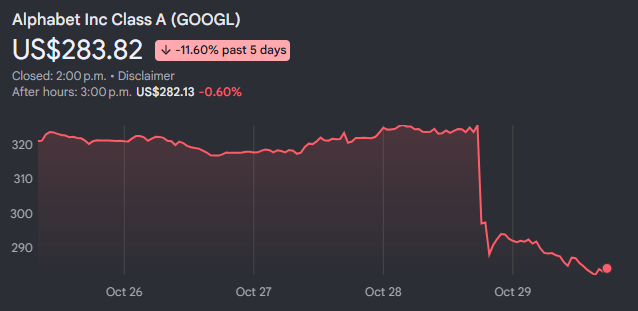
At first glance, that might seem strange.
Revenue grew 25% from a year ago. Google Search revenue grew 12%. Google Cloud revenue more than doubled, rising 103%. CEO Sundar Pichai said Search query growth was the strongest it has been in five years.
The problem wasn’t so much what Google earned. It was what Google spent.
Alphabet is pouring enormous amounts of money into data centres, computer chips and other infrastructure needed to develop and run artificial intelligence. Capital expenditures were more than $51 billion in the quarter, and that spending helped push free cash flow into negative territory.
Investors are now asking a perfectly reasonable question: what kind of return will all this spending eventually produce?
That question is particularly interesting for Google because AI has simultaneously been viewed as a threat to its most important business.
For more than two decades, when we wanted information online, we “Googled” it. Increasingly, people can ask ChatGPT, Gemini or another large language model a question and receive an answer without working their way through a page of search results.
In theory, that sounds threatening to Google.
In practice, things are more complicated. Search remains extremely profitable and, so far, AI appears to be increasing Google's search activity rather than destroying it. Pichai told investors,“Our AI investments are driving increased usage and overall query growth.”
Google is also far more diversified than the search box many of us still associate with the company.
It owns YouTube, which now has more than 150 million Music and Premium subscribers globally, including trials. It operates one of the world’s largest cloud-computing businesses. There are subscription, platform and device businesses, and its Gemini AI app has now reached one billion users.
Perhaps most interestingly, Google is becoming a major supplier of the infrastructure behind AI itself. Cloud revenue more than doubled this quarter, driven partly by demand for AI infrastructure and services.
And that brings us to the bigger story.
We are living through an extraordinary AI infrastructure boom. Google, Microsoft, Amazon, Meta and others are collectively building enormous quantities of computing capacity in the belief that AI will require it.
They may be right.
But history contains plenty of examples of humans becoming very excited about infrastructure.
Railroads. Telecom networks. Fibre-optic cable. Office towers. Shopping malls.
Sometimes we build too little. Sometimes we build too much. And occasionally we build the right thing at precisely the wrong price.
The telecom boom of the late 1990s is particularly interesting. Companies laid huge amounts of fibre in anticipation of explosive internet growth. There was eventually far too much capacity, several major companies failed, and investors lost fortunes. Yet all that fibre wasn't useless. Much of the infrastructure ultimately helped support the next generation of internet businesses.
AI could produce a similar paradox.
Today's data centres may prove incredibly valuable. Some of the equipment inside them may also become technologically dated surprisingly quickly. Unlike a railroad or fibre-optic cable, computing hardware can be leapfrogged by a new generation of technology while it still works perfectly well.
Google's business isn't shrinking. It's growing rapidly. But the company is spending enormous sums today because management believes the technological landscape is changing underneath it.
The market looked at that spending this week and didn't like what it saw.
Whether that spending eventually looks excessive or visionary may be one of the defining investment questions of the AI era.
Fraser Betkowski
The opinions expressed in this report are the opinions of the author and readers should not assume they reflect the opinions or recommendations of Richardson Wealth Limited or its affiliates. Richardson Wealth Limited is a subsidiary of iA Financial Corporation Inc. and is not affiliated with James Richardson & Sons, Limited. Richardson Wealth is a trade-mark of James Richardson & Sons, Limited and Richardson Wealth Limited is a licensed user of the mark. Richardson Wealth Limited, Member Canadian Investor Protection Fund.